
Managing Your ADHD the 3-S Way: Part 1 — Systems Beat Willpower
Welcome back! This is the next post in a series about the essential principles of managing your ADHD. In the first post I outlined the fundamentals of managing ADHD that I regularly share with my therapy clients. These posts are not therapy, but the principles still comprise the basic foundation — the non-negotiables — of successful, supportive, sustainable ADHD-management. I call it the 3-S Way.
As a reminder, these are the fundamentals of managing ADHD:
Successful → Addressing day-to-day challenges → Systems beat willpower
Supportive → Non-bullying motivation → Self-compassion beats shame
Sustainable → Getting back on track → Resuming beats spiraling
In this post we will take a look at what makes a Successful approach; that is, one that can effectively respond to ADHD-driven challenges in your daily life.
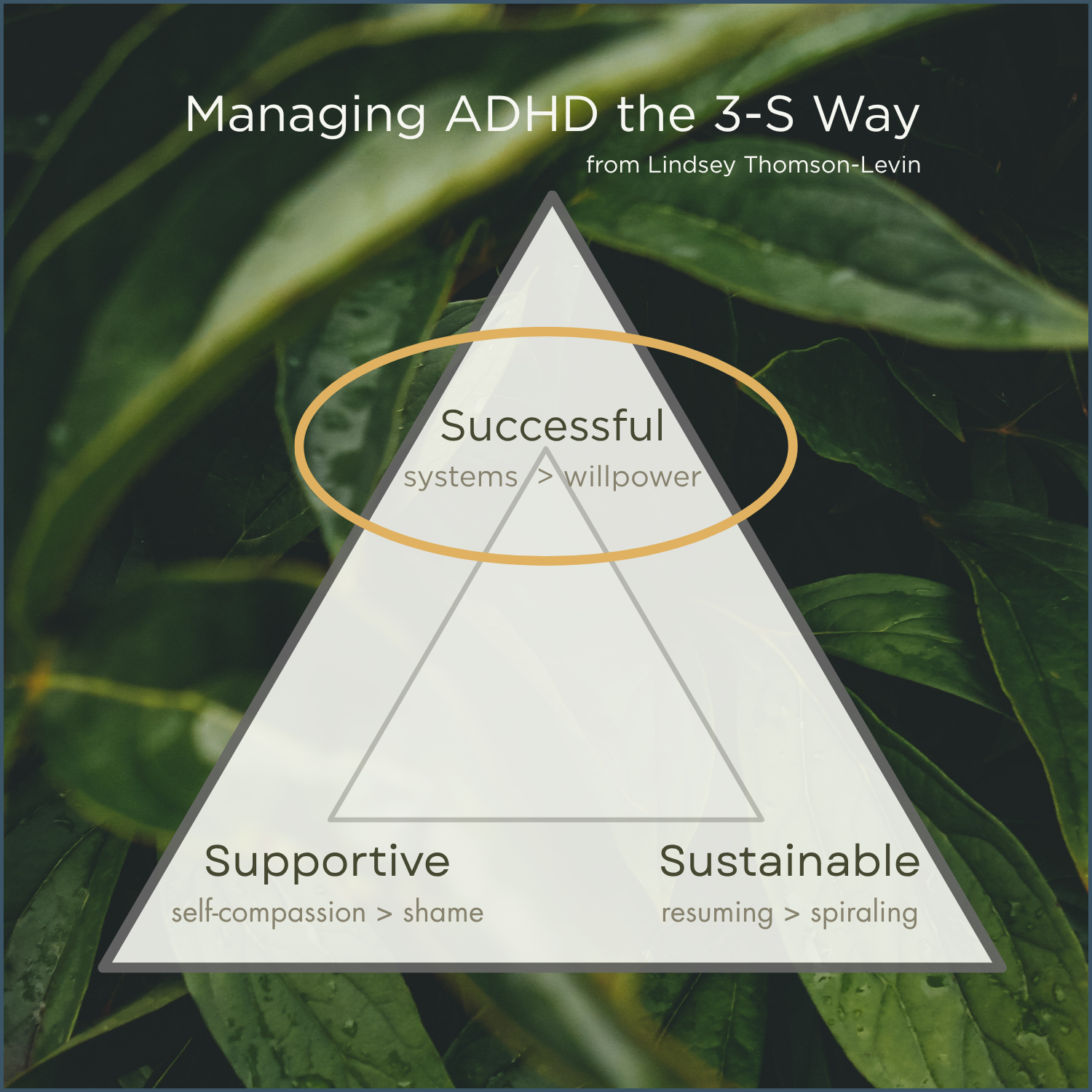
Successful: Systems Beat Willpower
Your ADHD is unique to your brain and your life. How it shows up, how it makes you who you are, and how it creates challenges are all different for each individual.
But when it comes to ADHD driving challenges in your life, one thing is consistent across all ADHD brains: it’s not a matter of trying harder. Willpower is not the issue.
Trying to overcome ADHD’s executive functioning challenges through willpower is working against your brain, not with it. In our culture we tend to think of willpower as an aspect of our character — if we are committed enough and strong enough and good enough, we’ll find a way to accomplish what we intend to do. But that’s not the whole story. Folks with ADHD can have high goals, the best intentions, and a clear understanding of the stakes involved, but mental effort is a function of the brain, not a reflection of one’s character. Willpower is in fact the knitting together of several executive functions; exactly the executive functions that ADHD undermines.
This is where systems come in to help support you in functioning day-to-day. Systems release the brain’s responsibility for holding everything and externalize the brain’s functioning, extending its capacity beyond the confines of your grey matter. The efficacy lies in how the system prompts you to act, instead of relying on your brain to do all the activating.
Some examples may help to illustrate this concept.
Types of Systems:
Here are just a few types of systems for addressing the day-to-day challenges of ADHD.
Routines: Building your day around routines frees up mental effort and decision-making power for times and tasks when you’ll need more capacity. Just winging it, or starting from scratch every day or in every instance, will burn through precious mental resources. Instead, figure out what part(s) of your life you can set up to run on autopilot — that might be getting out the door in the morning, structuring your workday, or doing household tasks on a regular schedule throughout the week.
Targeting Specific Skills: These will vary depending on your individual and specific executive functioning challenges, but whatever you struggle with, you can create a system to set yourself up for success. Whether it’s time blindness, task initiation, disorganization, or anything else, tools and strategies can make all the difference. There’s not space here to list every strategy for every executive function, but there’s a wealth of “executive function cheat sheets” online, or feel free to reach out to develop a plan together!
Mindfulness: If you struggle with some hyperactive-impulsive ADHD symptoms, such as blurting things out or making impulsive purchases, you can still use a system to manage them rather than berating yourself afterwards and telling yourself not to do that next time. For example, the mindfulness-based STOP method (Stop, Take a breath, Observe, Proceed) is a protocol for pausing in the moment, centering yourself with the breath, noticing what’s happening in your mind and body that you’re responding to, and then either carrying on as you were or choosing a different next step. With practice, this can be an effective system to help manage and regulate unwanted impulsive behaviors.
Now, how do you get yourself to implement and stick with these systems? We’ll dive into that in the next post. Let’s keep going!