
The Dual Process Model of Grief: Permission to Zone Out Sometimes
How do you take a deeply personal, profoundly emotional, and possibly sacred experience and make it dry as dust? Run it through the academia machine! Welcome to today’s post about the “dual process model of grief.”
Why bother exploring this here? While academic models may seem completely detached from the real-life experience of grieving, I find that a lot of folks actually appreciate knowing that many others have gone through the same thing they are; that the grief process is meaningful enough to study and strive to understand; that their experience is recognizable, relatable, and makes sense.
And also, it’s good to get the word out that there are ways to conceptualize grief beyond the famous/infamous five stages! So let’s take a look.
When Margaret Stoebe and Henk Schut first published their work on the dual process model in 1999, it was a shift from the predominant theories of the time — namely “grief work” theories, which stated grievers must directly confront their pain and work through their feelings (in tasks or stages) in order to fully process their grief.
In contrast to this full-body contact with grief, Stoebe and Schut’s dual process model describes a process that many of us may find familiar: oscillating between loss-oriented coping (e.g. thinking about the loss, remembering and reminiscing, looking at pictures, focusing on grief explicitly through therapy or a support group) and restoration-oriented coping (e.g. adapting to new a reality, having new experiences, managing changes in role or identity, distraction from grief, even engaging in denial or avoidance), all while everyday life carries on.
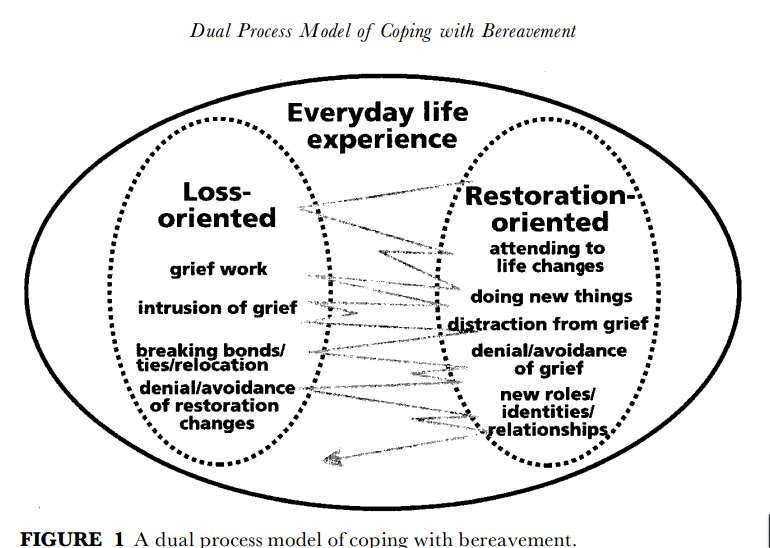
What is this all really saying? To me, the dual-process model validates what many of us experience firsthand: that grief comes in waves, that we face the most difficult and devastating parts of grief a bit at a time, and that continuing to live your life after loss — whether it’s figuring out how to do something your loved one used to do (restoration-oriented coping) or basic functioning in a new, post-loss world — is part of grieving too.
And did you catch that distraction is right there in the model? So if you’re grieving, go ahead and enjoy that mindless show or that cleaning spree or that laugh with a friend. It’s all part of the process.