
Managing Your ADHD the 3-S Way: The Fundamentals
If you have ADHD, hopefully you know that it’s a brain-based difference, usually passed down in families, and it won’t go away — it’s part of you. Managing ADHD is a lifelong journey, but you absolutely can take control of your symptoms and live a less chaotic, more satisfying life.
(Please know that I wholeheartedly acknowledge the cruel irony that folks with ADHD often have trouble managing tasks and processes, and the solution to this is just one more thing to manage. It takes clarity, intention, and effort to commit to the work anyway. And the anger and grief about it is real! If you need space to process your feelings about life with ADHD and support in implementing the tools that follow, please reach out.)
In an age when we’re constantly bombarded with online content, it can be tempting to reduce managing ADHD to simply mastering all the “hacks,” as if ADHD could be tamed through a series of “this one weird trick” videos. Setting aside the amount of mental health misinformation on social media, it’s important to understand that managing ADHD is more than knowing all the tips and tricks. From my perspective, there are three fundamental truths about what it takes to manage ADHD. Not specific tools (not yet), but essential foundations of your approach:
1) Yes, folks with ADHD need to take practical, actionable steps to manage it — do nothing and you run a high risk of ADHD messing up various parts of your life.
2) But the way you manage it must protect your self-worth: you can’t bully yourself into action. That’s not an effective strategy long-term and it will rack up additional emotional consequences, like depression and anxiety (which already often co-occur with ADHD).
3) And finally, a good approach to managing ADHD has to assume that systems will fall apart and plans will get off track from time to time. That’s just what ADHD does. We need to anticipate that bump in the road and bake in our readiness to get back on track.
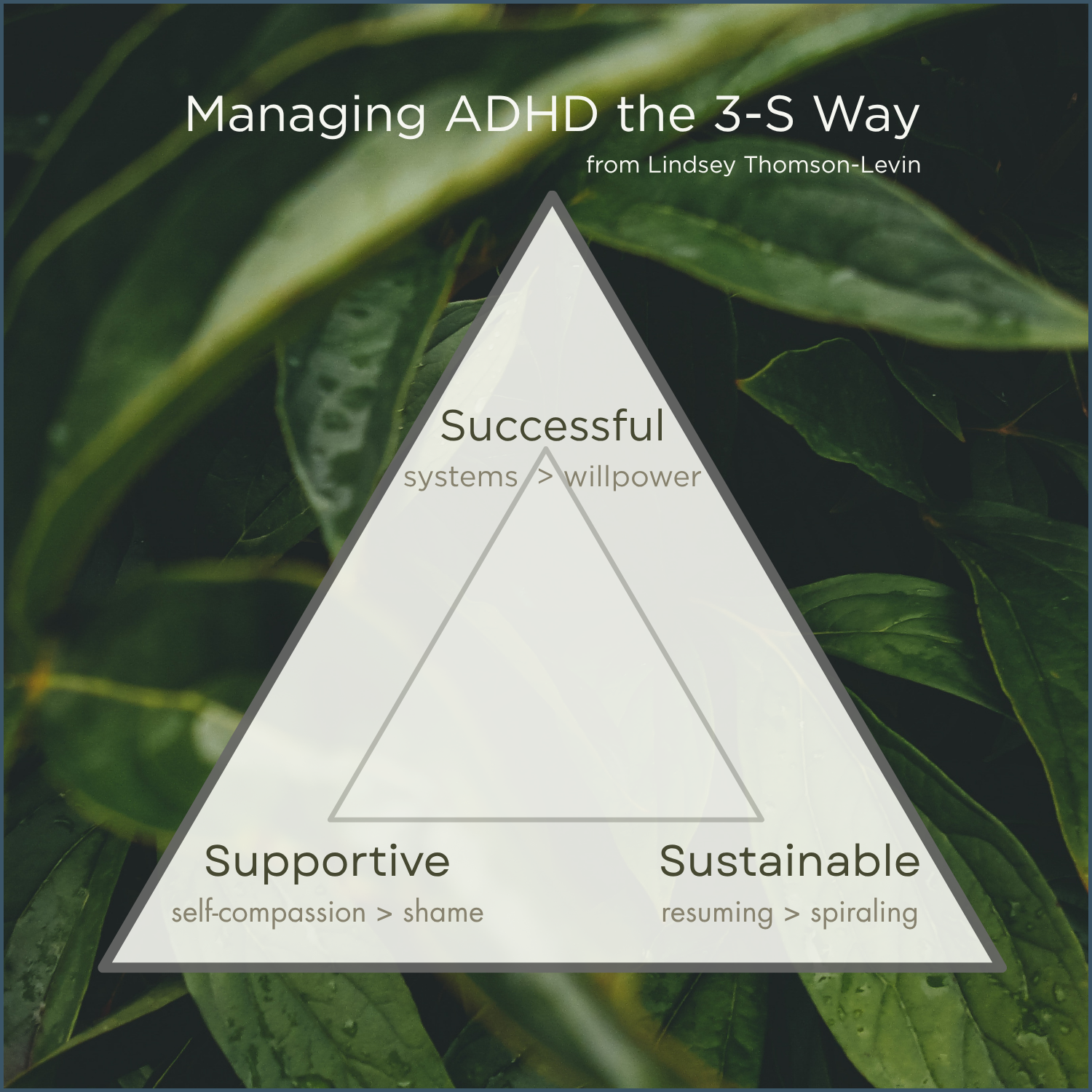
To restate, a complete approach to managing ADHD must be:
Successful — Effective in addressing day-to-day challenges
Supportive — A non-bullying way of motivating and talking to yourself
Sustainable — Ready to get back on track when things inevitably fall apart
I call this approach the 3-S Way. Each “S” mutually reinforces the others, and the approach falls apart if any one of them is missing. It’s a worthwhile thought experiment — try combining different pairs and then assume the third fundamental S missing. What happens?
Now, what does each of these look like in practice? It’s all about knowing what works and what doesn’t.
Successful — Addressing day-to-day challenges — Systems beat willpower
Supportive — Non-bullying motivation — Self-compassion beats shame
Sustainable — Getting back on track — Resuming beats spiraling
In the next three posts, we’ll look more closely at each one and how to operationalize it in your own life. Stay tuned!