
Managing Your ADHD the 3-S Way: Part 2 — Self-Compassion Beats Shame
Welcome back to this series about the essential principles of managing your ADHD.
As a reminder, these are the fundamentals:
Successful → Addressing day-to-day challenges → Systems beat willpower
Supportive → Non-bullying motivation → Self-compassion beats shame
Sustainable → Getting back on track → Resuming beats spiraling
First I outlined the fundamentals of managing ADHD, and then we looked at systems as a better choice than willpower for tackling ADHD-driven challenges in your daily life.
In this post we will take a look at what makes a Supportive approach, or how self-compassion will bring you closer to your goal of well-managed ADHD than shaming yourself will.
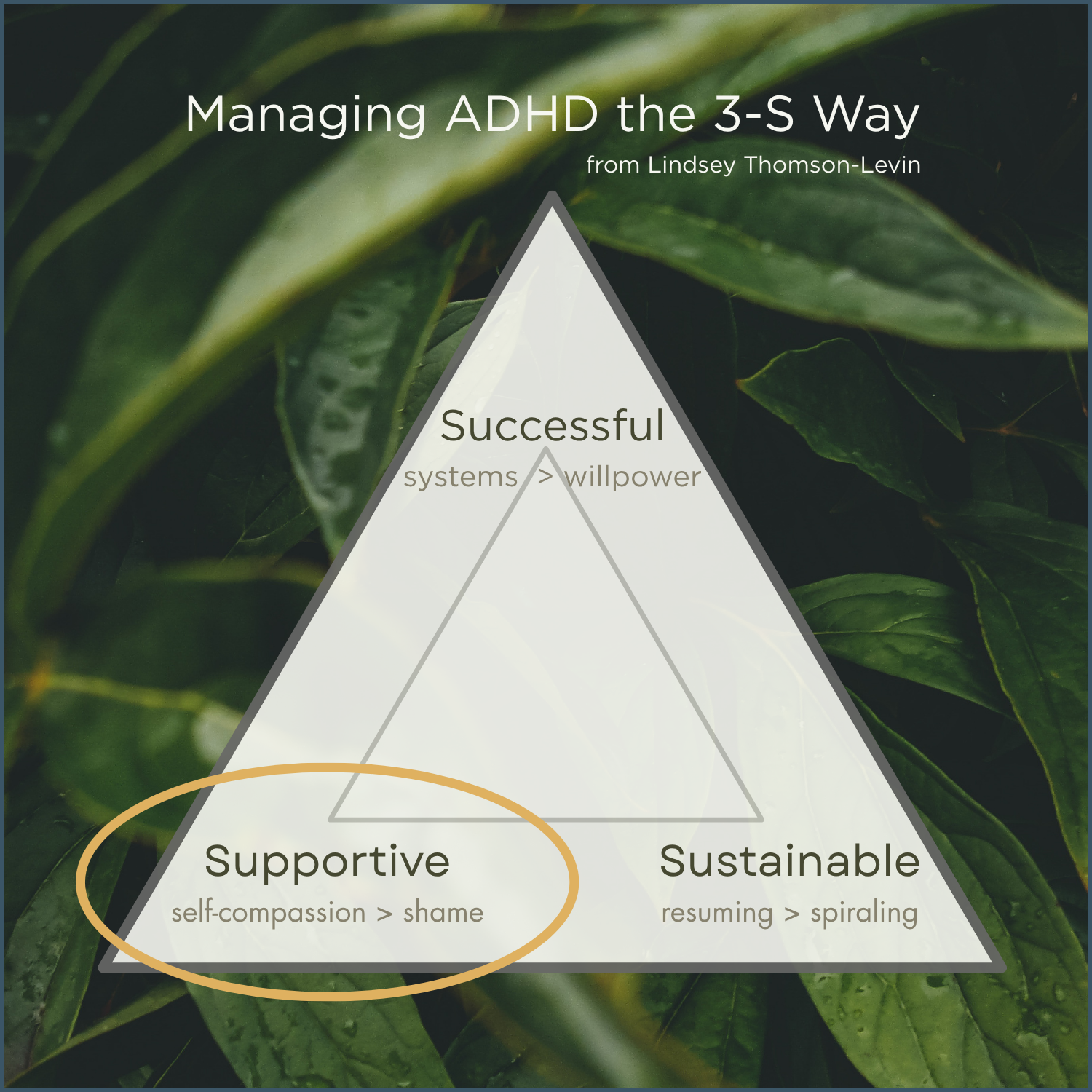
Supportive: Self-Compassion Beats Shame
As a reminder, self-compassion is not self-indulgence. Many folks with ADHD who have struggled with executive function challenges may have a negative (and false) belief about themselves that they are lazy; when they hear “self-compassion,” they may reflexively think, “No! I actually need LESS of that!!” So, to address the skeptics out there right from the start, self-compassion is not self-indulgence, passivity, or excuse-making. Rather, it is a kind and understanding stance toward ourselves and our mistakes, which is entirely compatible with high goals, high expectations, and self-accountability. Here again are the findings of self-compassion researcher and expert Dr. Kristin Neff:
Self-compassion involves the desire for the self's health and well-being, and is associated with greater personal initiative to make needed changes in one's life. Because self-compassionate individuals do not berate themselves when they fail, they are more able to admit mistakes, modify unproductive behaviors and take on new challenges (Neff, 2009).
Bullying, shaming, or harshly disciplining yourself is actually not the way to motivate yourself, recover from mistakes, or make important changes going forward. Practicing self-compassion with ADHD (more on that in this post) doesn’t mean letting yourself off the hook, but neither does it mean coming down hard on yourself. If you are committing to managing your ADHD, you deserve credit for your successes and grace for your struggles. This is, in essence, being a supportive friend to yourself: a friend who supports both your goals and your wellbeing.
There’s another reason for people with ADHD to adopt a kind stance toward themselves: demand avoidance. Demand avoidance in ADHD presents as resistance to or withdrawal from a given task, usually due to executive function challenges with task initiation, organization, planning, etc. The overwhelm in the brain — combined with anxiety, stress, or frustration — results in a freeze or stuckness response. What helps is lowering the intensity of the language and mindset around the task, breaking the task into manageable pieces, and sweetening the deal with something enjoyable or stimulating. What doesn’t help is laying on the shame, urgency, and criticism, as it will only exacerbate the overwhelm.
A few examples of the difference between compassionate and shaming self-talk:
Self-Compassion as Motivation
Shaming: Try not to screw this up like you always do. Maybe you’re just not cut out for this.
Compassionate: I believe in my ability to achieve whatever I put my mind to. Part of that means acknowledging where I struggle and taking responsibility for managing myself. I’m doing that, and also I trust myself to get up if I stumble. We are all doing our best, and we are all deserving of love.
Self-Compassion After Making a Mistake
Shaming: I can’t believe I lost track of time/forgot to do that important thing/lost that important document/etc.
Compassionate: I’m feeling frustrated and discouraged that I made this mistake. Everyone makes mistakes, it’s part of being human, and I’m still a good person. Now, what do I need to do to take responsibility here and then try to prevent this from happening again next time?
Self-Compassion to Counter Demand Avoidance
Shaming: Ugh, I NEED to get started on this! I’m already so behind and I don’t want to be late with it AGAIN.
Compassionate: I want to get started but it’s feeling hard to do that right now. That makes sense; this is just one of those ways my ADHD shows up. Let’s take a breath, [get a favorite drink or turn on some music, e.g.], and do the very first microscopic step.
In the final post of this series, we’ll explore what happens when all your best intentions and systems slide off track, how to stop the slide or the spiral, and how to get back to doing what you know works for managing your ADHD.