
Managing Your ADHD the 3-S Way: Part 3 — Resuming Beats Spiraling
Here we are at the final post in this series about the essential principles of managing your ADHD.
As a reminder, these are the fundamentals:
Successful → Addressing day-to-day challenges → Systems beat willpower
Supportive → Non-bullying motivation → Self-compassion beats shame
Sustainable → Getting back on track → Resuming beats spiraling
We started with the fundamentals of managing ADHD, and then looked at the role of systems and compassionate self-talk in supporting your goals.
Finally, in this post we will get into what makes a Sustainable approach to managing ADHD, in which setbacks do not set off a downward spiral and instead we can quickly get back on track.
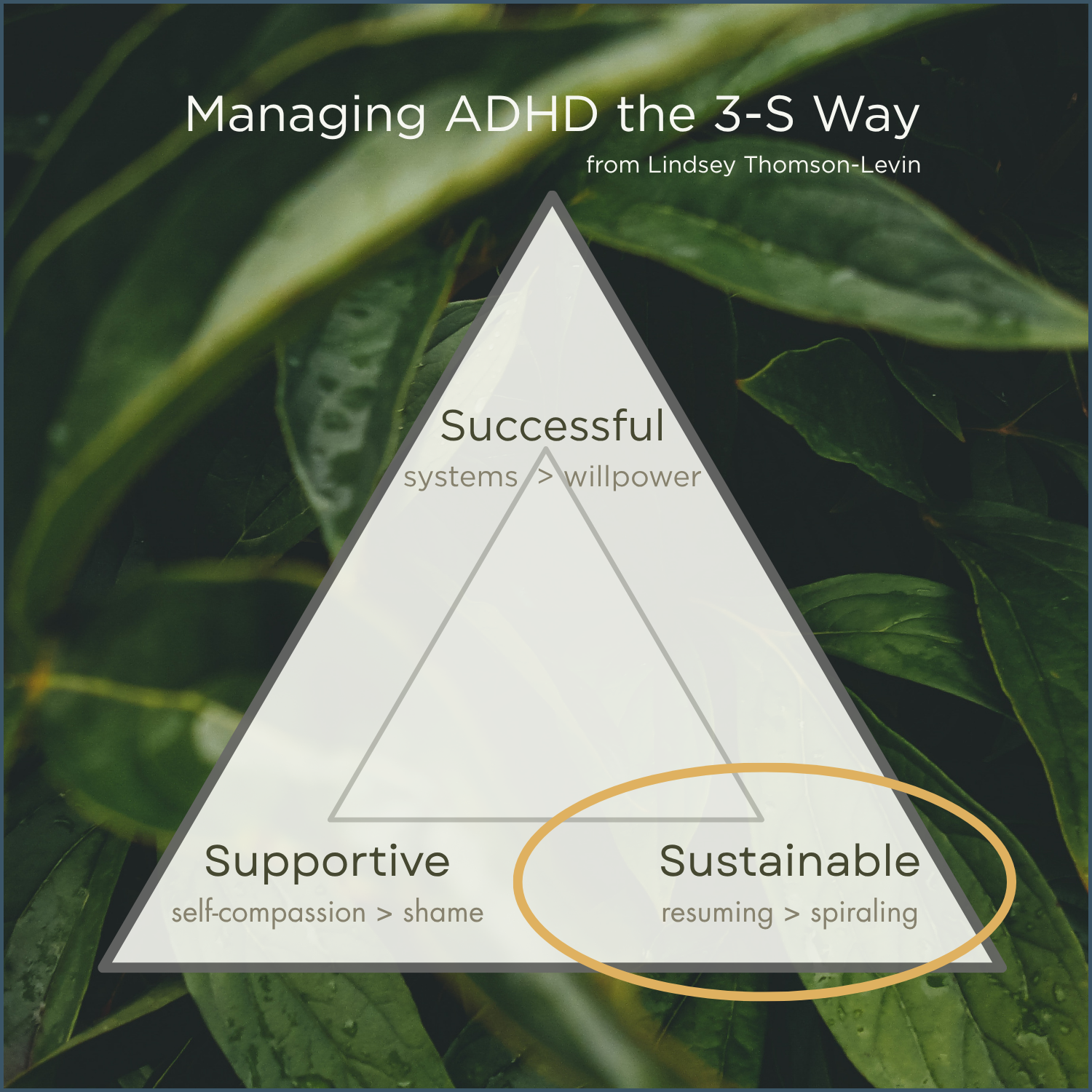
Sustainable: Resuming Beats Spiraling
With ADHD, it’s rarely a matter of whether your systems and strategies will take a hit. It’s a matter of when. A simple and cruel reality is that ADHD makes it hard to do the things necessary to manage ADHD. So, we will sometimes stumble in that effort.
A disruption to your schedule throws off your routines. A few days down with the flu zaps the energy it takes to put effort into your executive functioning tools. A major stressor or life transition distracts you from keeping up with your systems or strategies and/or maintaining your compassionate self-talk.
And then what happens?
If you have a pre-existing negative belief about yourself that you’re worthless or you’re a failure, it will be hard to pick your systems back up or return to your routines. There’s no reason to think that you can, or that it will make a difference.
If you have a tendency toward “all or nothing” thinking (very common with ADHD) then you may throw in the towel on all your hard work because everything is already ruined. You might even pile on some more self-destructive behaviors in order to underscore the fact or to soothe yourself in your disappointment or anger.
This is spiraling. You’re down on yourself. Your ADHD is going unmanaged and you’re accumulating more stress and negative outcomes from that, so you’re getting even more stuck. Your life is getting worse, and so on. A downward spiral.
Managing your ADHD requires a sustainable approach, because all the systems, strategies, tools, and self-compassion in the world can’t help you if you abandon them when life intervenes or when your ADHD wins a round for once. Instead, we need to anticipate that stumbles and setbacks will happen. We need to expect the disruptions and bake in our plan to get back on track. If we plan for imperfection, we can be ready with our recovery tools. These tools might be:
Mindful noticing: Observe what’s happening inside and put it into words. “I’m upset because I got off track.” We name it to tame it, and separate the temporary feeling state from our identity.
Resetting: External changes can signal to the brain that it’s time to shift mood or mode. Take a walk, take a shower, even change your clothes.
Letting go of the past: Resume from where you are, don’t try to make up for time that has passed. You don’t need to do more to compensate, just start from here.
Microscopic momentum: Getting back on track might seem like climbing a mountain if you look all the way to top. Instead, take the tiniest possible microscopic step. Clean one item. Write one sentence.
To close this post, and the series altogether, I’d like to share why I lean toward the language of “resume” and not “start over.” For one thing, the language we use shapes our beliefs and our emotional states (part 2 in this series was all about this), and words like “resume” or “continue” don’t feed into failure-sensitive, all-or-nothing thinking the same way that “start over” does.
For another, I don’t believe that we ever start over in life — no matter what the process or task, once we have begun it for the first time, we are never brand new to it again. We will always bring more experience, perspective, or wisdom to future inflection points. In this sense, I simply feel it’s more accurate to say that we resume the work rather than start over.
And finally, “resume” is more properly aligned with the greater purpose of managing your ADHD: to be honest about how your brain works and meet yourself where you are, in order to — ultimately — live better. We don’t create calmer, more fulfilling lives by holding ourselves to impossible standards and breaking our own backs to get there; we identify what we need and we do what works for us in order to function better. “Starting over” means that we expected perfection, perfect adherence and performance, and failed. “Resume” expects interruptions, plans for them, and doesn’t allow them to take us down. When we resume, we reach out our hand and help ourselves up when we stumble. Resuming is how we get back up.
Wherever you are with your ADHD, my sincerest wish is that you find what works for you, treat yourself with kindness and care, and help yourself up when you fall. And if you feel you would benefit from some support in this effort, I would be honored to partner with you.