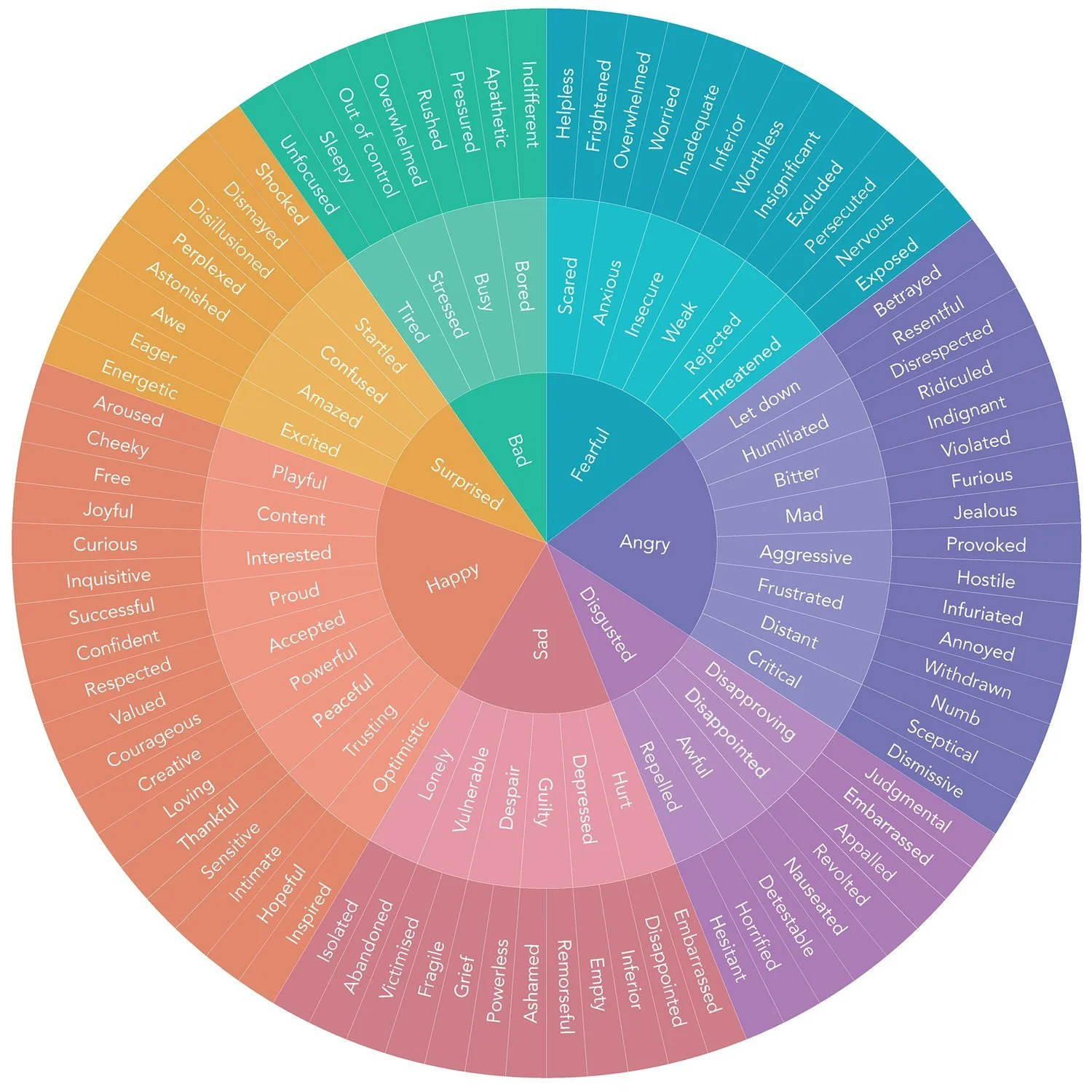
The Emotions Series: The Feelings Wheel
Having the right tool for the job makes all the difference.
I once spent hours, over several days, scrubbing at a cooking pan with only moderate success. Then someone suggested the cleanser Bar Keepers Friend, which dispensed with the job in a few minutes. (No connection to Bar Keepers Friend — just a big fan because it is actual magic!)
The feelings wheel is a bit like that. It’s a simple tool and at first may even seem too basic to be useful. But when we’re experiencing big or difficult emotions, it can be exactly what we need to get unstuck.
The concept originated in 1980 with psychologist Robert Plutchik, who designed his “Wheel of Emotions” around what he theorized were the eight primary human emotions. In 1982, psychologist Dr. Gloria Willcox published her “Feeling Wheel,” which involved a much wider range of emotions. From there, many clinicians and counselors have created additional versions, all of which help individuals name — and then perhaps tend to — the feelings we’re having in any given moment.
Typically a feelings wheel has a handful of broad emotional terms in the center, such as happy, angry, sad, etc. The next ring out from the center will list several more specific emotions; within sadness, there might be hurt, depressed, lonely, etc. Then the next outward ring will break down each of those emotions even further; within lonely, it might offer isolated versus abandoned.
In this way, the feelings wheel can help guide us from our general feeling down into the specific experience we are having: to feel abandoned is far different from feeling sad, and knowing what’s really going on inside can help us see what we might need in that moment. Once we’re aware that we’re actually feeling abandoned, we might reach out to a trusted loved one for comfort, or better communicate our feelings to the person we feel abandoned by.
But even if we can’t or don’t take specific action to address a feeling, just identifying it and naming it can help us soften toward that feeling and allow it to move through us. (Read more on how to sit with a feeling here.)
To have an easier relationship to our emotions, it is essential to (1) recognize our feelings as they arise and (2) have a diverse vocabulary to describe them. When we can observe and identify a feeling, it becomes a fleeting experience, something passing by, and not our fixed reality. It’s not who we are. Creating that distance between a feeling and our identity — I’m feeling abandoned, rather than I am abandoned — is a powerful step toward emotional freedom. Emotions will come and go, and yet we can stay sturdy and grounded, and even at peace, through it all.
Give it a try here or below, or feel free to do some online searching for a feelings wheel that works for you.